Textile guide Bedding
Choosing a Coyuchi Duvet Cover: Weave, Fit, and Care
A duvet cover is both the first thing you feel at bedtime and one of the most frequently laundered pieces in a bedroom. When considering a Coyuchi style, look beyond color and mood: fiber, weave, construction, dimensions, and care instructions determine how the cover will feel, fit, and wear.
Published November 16, 2026
There is a particular pleasure in a bed that feels considered without appearing overworked. A duvet cover can set that tone: crisp or softly rumpled, light and airy or substantial in the hand, quietly plain or finished with a border that catches the eye. Yet the most persuasive details are not always visible in a product photograph. The weave shapes texture and drape; the dimensions determine whether the cover sits neatly over its insert; and the closure and interior ties influence how well the duvet behaves overnight.
Choosing among Coyuchi duvet covers, or assessing any cover in the same thoughtful way, starts with the product’s own specifications. Brand names and collection descriptions offer context, but they cannot substitute for the details of an individual style. Fiber content, construction, dimensions, closure, and laundering guidance may differ across a range. A little close reading before purchase can spare a great deal of adjustment later—and help a beautiful piece earn its place in daily life.
Begin with the fabric, not the photograph
Images are useful for judging color and overall styling, but they can make fabrics with very different hand-feels appear nearly identical. Begin instead with the stated material. A cover described as cotton, linen, or a blend will have a different character, and even two fabrics made from the same fiber can feel distinct because of their weave, yarn, weight, and finishing.
Fiber content is the foundation of the decision. If a listing identifies a cover as 100% linen, that tells you what fiber is used, but not the whole story: it does not, by itself, tell you the fabric’s weight, softness, weave density, or how it will relax with washing. Likewise, a cotton cover may range from smooth and tightly woven to textured and more open. Check the full specification rather than inferring a tactile experience from the word “linen” or “cotton” alone.
Finish matters, too. Terms such as garment-washed or stone-washed describe treatments intended to alter the fabric’s surface or feel, but the exact result varies with the material and process. A pre-washed cover may feel less crisp at the outset than an untreated fabric, while a relaxed finish may make creasing part of its intended appearance. Treat finish language as a helpful clue, not a guarantee that every person will experience the fabric in the same way.
For a considered comparison, look for the following in the product details:
- Fiber content: Confirm whether the cover is linen, cotton, or a blend, and check whether the percentage is stated.
- Fabric weight: If provided, weight can help distinguish a lighter, more fluid fabric from one with a more substantial feel.
- Weave or surface: Look for a named weave, a description of texture, or details about the fabric’s finish.
- Origin and certification: Read these as specific sourcing or production information, not as a substitute for construction and care details.
- Care label: Confirm the washing and drying method before deciding whether the fabric suits your routine.
What a duvet cover’s weave can tell you
Weave describes how yarns intersect to form fabric. It influences the surface you touch, the way a cover falls over a duvet, and the visual character of the bed. It is one of the most useful terms in bedding materials—and one that is often left unmentioned in short product descriptions. If a specific Coyuchi listing does not name its weave, avoid guessing from the collection name or from photographs. Ask the maker or retailer for clarification when the distinction is important to you.
A plain weave has a straightforward over-and-under structure, though the final hand-feel varies with yarn and finishing. Sateen is a woven construction associated with a smoother-looking surface; the name refers to structure rather than a fiber, so a sateen fabric is not automatically silk or satin. Percale is another cotton weave commonly associated with a crisp, matte character, but a fabric’s actual feel also depends on thread, finishing, and use. These terms are useful points of comparison when they appear in a product’s verified specifications.
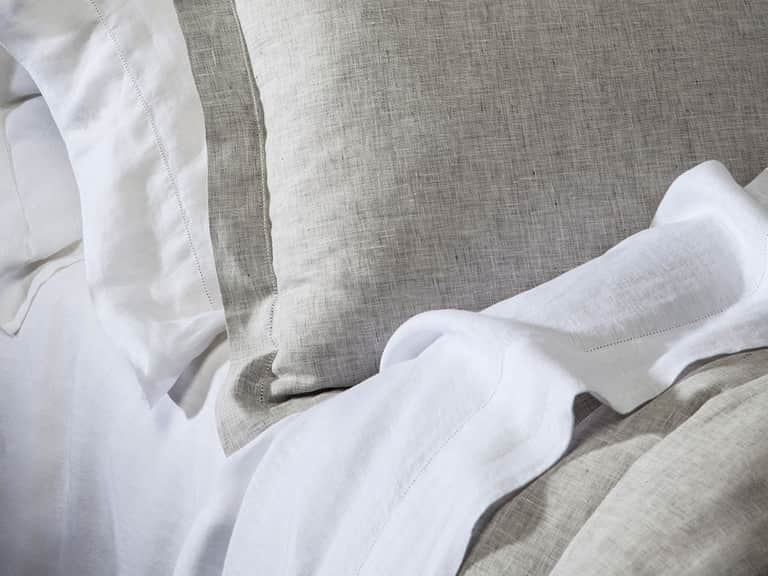
Linen is valued for its natural, irregular texture and its relaxed drape. Depending on how it is woven and finished, linen bedding may feel crisp at first, soft from the start, or somewhere between the two. It can crease more visibly than some smoother fabrics, which is not necessarily a flaw; for many people, that ease is part of its appeal. A tight, polished bed and a softly lived-in one are simply different aesthetic choices.
Weight can clarify the mood of a fabric. A lighter cover may feel fluid and easy to move, while a heavier textile can create a more grounded, enveloping appearance. Weight alone does not determine comfort, however. Room temperature, duvet filling, personal preference, and the way the cover is constructed all play a part. If a product page gives weight in grams per square metre or another unit, use that information to compare like with like—not as a universal ranking of quality.
Consider texture in the context of the whole bed
A duvet cover does not perform in isolation. Its texture sits beside the fitted sheet, pillowcases, blankets, and the duvet itself. A smooth cover paired with crisp sheets creates one impression; a textured linen cover layered over a quieter base feels more relaxed. Neither approach is inherently better. The useful question is whether the layers work together in both touch and appearance.
Color can sharpen the effect of texture. Pale, undyed-looking neutrals make a fabric’s surface variation easy to notice; deeper shades can give a bed a more tailored, grounded presence. If color accuracy matters, consult the maker’s current product information and remember that screens, lighting, and surrounding colors can affect how a shade appears. Do not assume that a particular hue or finish will be identical across different collections or production runs.
Details at the edge deserve attention as well. A flange, hemstitch, or wide border changes the visual finish and may influence how formal or casual the cover feels. These details do not tell you whether the fabric is durable, but they can help you decide whether the design suits your room. Check descriptions carefully: a decorative detail on a pillow sham should not be assumed to appear on the duvet cover unless the listing says so.
Getting the fit right
Good duvet cover sizing begins with measurements, not with the bed size printed on a label. A queen duvet insert and a queen duvet cover may not have identical dimensions across every maker or collection. Measure the insert itself, then compare its width and length with the cover’s stated finished dimensions. If you are replacing only the cover, use the measurements of the duvet you already own rather than relying solely on its size name.
A cover that is substantially larger than its insert may look loose and can allow the filling to shift into empty corners. One that is too small can compress the duvet and make the bed feel less generous. Some people prefer a slightly relaxed fit; others want a clean, close outline. The important point is to understand the actual dimensions before choosing, and to confirm whether the product page lists the cover’s dimensions, the recommended insert size, or both.
Mattress depth is relevant to fitted sheets, but it does not determine the size of a duvet cover. Keep the two decisions separate. When comparing options, note the cover’s listed measurements in the same units as your insert; converting inches to centimetres, or the reverse, can help prevent a mistaken comparison. If dimensions are missing, inconsistent, or unclear, request confirmation rather than estimating from a product photograph.
Think about how much coverage you want at the sides of the bed. The desired drop depends on the width of the mattress, the thickness of the duvet, and the way the bed is styled. A cover that looks perfectly proportioned on one bed may appear shorter on another. If you share a bed or prefer a generous overhang, compare the finished duvet width with the mattress width and consider whether the insert’s loft will change its apparent coverage.
Closures and interior ties: small details, real consequences
The closure is a practical detail worth checking before a purchase. Duvet covers may use buttons, snaps, ties, a zipper, or another system. Each affects how quickly the cover can be removed for laundering and how discreetly the opening sits when the bed is made. There is no universally ideal closure; choose the one that best fits your preferences and confirm the mechanism for the specific style.
Interior ties or loops can help connect the duvet to the cover at the corners, limiting movement as the bed is used. Their presence, placement, and number vary by product. A listing may mention corner ties, but it is still sensible to confirm whether the insert has corresponding loops or another way to secure them. If there are no internal fastenings, the duvet may shift more readily, depending on its construction and how the bed is used.
Read closure details alongside the dimensions. A carefully sized cover with secure interior fastenings can make a duvet easier to arrange, while a closure that is awkward to manage may complicate wash day. Consider who will be changing the cover and how often. A refined finish is lovely; an uncomplicated routine is lovely, too.
Care is part of the selection, not an afterthought
The best laundering routine is the one specified for the exact item. Recommendations can differ even among covers made from the same fiber, because dyes, finishes, construction, and maker guidance are not always the same. Before buying, locate the care instructions and make sure they are compatible with your household routine. Do not assume that every linen duvet cover can be washed and dried in the same way, or that a cotton cover necessarily tolerates high heat.
When the label permits machine washing, avoid packing the washer so tightly that the fabric cannot move freely. Use the detergent and cycle recommended by the maker, and separate colors as appropriate. Overloading can make it harder to rinse thoroughly and can place unnecessary strain on seams and closures. If the care label calls for a delicate cycle, or advises against a particular treatment, follow that direction rather than relying on a general rule for bedding.
Drying deserves equal care. High heat and over-drying can be tough on many textiles, but the correct method depends on the item’s instructions. If line drying is recommended, allow adequate space for air circulation. If tumble drying is permitted, use the temperature stated on the label and remove the cover when it is dry. Linen’s natural creasing can be accepted as part of its relaxed character; ironing should be guided by the specific care directions and the finish you prefer.
For everyday upkeep, airing the bed and changing the duvet cover on a regular schedule can help maintain a fresh sleep environment. The right interval depends on personal habits, climate, and household needs. Between washes, avoid unnecessary exposure to direct sunlight if the maker advises care with color retention, and keep the cover away from rough surfaces or hardware that might snag the weave. Small, consistent habits are often more useful than aggressive cleaning.
How to read product descriptions with confidence
Product pages often combine evocative language with useful specifications. Words such as “soft,” “airy,” and “relaxed” can suggest an intended experience, but they are subjective. A more reliable comparison starts with measurable or verifiable details: fiber content, dimensions, construction, closure, interior ties, origin where stated, and care requirements. When a description is silent on one of these points, treat the missing information as unknown rather than filling the gap with an assumption.
Keep the product name and collection name distinct from the item’s actual specifications. A collection may include sheets, pillowcases, shams, and duvet covers, each with different construction or finishing. Details given for one piece should not automatically be applied to another. Confirm that the information you are reading belongs to the precise duvet cover, size, and color under consideration.
Certifications, when listed, should also be interpreted carefully. A certification relates to the scope and criteria of that particular standard; it does not, by itself, answer every question about hand-feel, longevity, or care. Read the certification name and its stated scope from a reliable source, and keep it separate from practical questions such as whether the cover fits your insert or can be laundered at home.
A concise checklist before choosing
Before settling on a Coyuchi duvet cover, review the details in a calm, methodical order:
- Confirm the exact fiber content and, if available, the weave, fabric weight, and finish.
- Measure your duvet insert and compare its width and length with the cover’s published dimensions.
- Check the closure type and whether interior ties or loops are included.
- Verify that the product details apply to the duvet cover itself, not just another piece in the collection.
- Read the care instructions and consider whether they suit your washing and drying routine.
- Choose a texture and finish that make sense alongside your sheets and other bedding.
- Contact the maker or retailer if a critical specification is missing or unclear.
The final consideration: how you want the bed to feel
A duvet cover is a close-to-the-skin textile, a frame for the duvet, and a quiet contributor to the atmosphere of a room. The right choice is not necessarily the most elaborate or the one with the longest list of claims. It is the cover whose material, feel, proportions, details, and upkeep suit the way you actually live.
For Coyuchi duvet covers in particular, make the specific product listing your final authority. Compare the stated weave and fiber, check the closure and interior ties, measure against your duvet, and follow the item’s own care instructions. These practical steps leave room for the pleasure of choosing—texture against the hand, a color that softens the room, a finish that feels like you. When the fundamentals are right, the bed can look effortless because the details have been considered.